Aetharikolo
A constructed language for the Aethari peoples, built from scratch and wired into the narrative engine
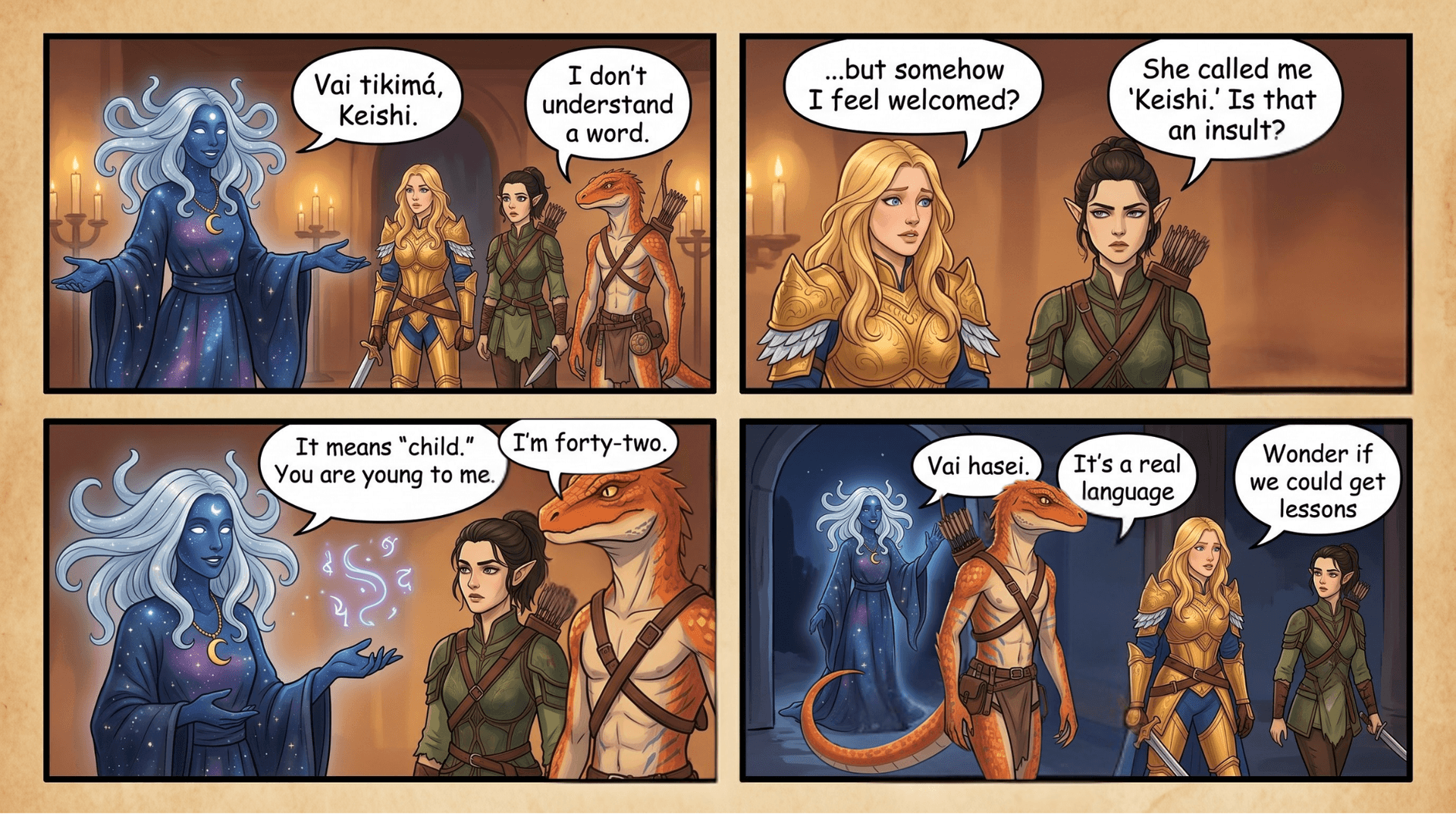
Chronicles of Terros has a new language. Aetharikolo is the shared mother tongue of the three Aethari peoples: the Kameiári (Voidwalkers), Iliénari (Starkin), and Analiári (Crystalborn). It was designed by acaleyn, who built a full grammar from scratch — phonology, verb morphology, pronouns, numerals, derivational suffixes, and a vocabulary of several hundred words. We integrated it into the narrative engine so that Aethari NPCs speak it alongside Common.
Why a Constructed Language
The Aethari arrived in the Veridian Reach from Aethermoor during the Convergence. They have been living alongside Valenhall's original peoples for a century. That is long enough for cultural exchange but short enough that their language, customs, and identity remain distinct.
Most games handle this with flavour text — "she speaks in an unfamiliar tongue" — and move on. We wanted the player to actually hear it.
When a Starkin elder greets you with "Vai tikimá, Keishi" instead of "welcome, young one," the world feels inhabited in a way that a description of foreignness cannot match. The player does not need a glossary. Context and the surrounding narrative carry the meaning. But the words are real, consistent, and follow rules. An NPC who says "Vai hasei" (go well) at the end of a conversation will say it the same way next time, because the grammar behind it is stable.
How acaleyn Built It
Aetharikolo has Polynesian-inspired phonology: open syllables, vowel-heavy, no consonant clusters. The stress system and syllable structure give it a sound that separates it from Common, which maps roughly to English in the game world.
A few structural choices shape how Aethari NPCs talk.
The Tense System
Aetharikolo verbs distinguish only "present" from "not-present." Past and future use the same verb form. The not-present tense splits further by whether the speaker has direct knowledge of the event (attested) or does not (unattested). When an Aethari NPC speaks Common, this bleeds through. They might say "it happens" when describing something from decades ago, or "I have seen" when making a prediction. The grammar reflects how they experience time. Older speakers show it more.
The Honorific System
Aetharikolo honorifics are gender-neutral and based on perceived relative age. "Kufumi" (grandparent) for someone two generations older. "Mahemi" (parent) for one generation up. "Kaikue" (sibling) for a peer. "Keishi" (offspring) for someone younger. "Mapuna" (grandchild) for someone much younger. The honorific follows the name: "Leli Kufumi" from a young adventurer, "Phase Kaikue" between peers. There are no gendered titles. This replaces sir, madam, and lord entirely for Aethari characters.
The Endonyms
The Aethari do not call themselves Voidwalkers, Starkin, and Crystalborn. Those are Common translations. Among themselves, they are Kameiári (people of the void), Iliénari (people of the stars), and Analiári (people of the crystal). Collectively, the Aethari. Their language is Aetharikolo, from "Aethari" + "kolo" (speech): tongue of the Aethari.
How It Works in the Game
The game detects when Aethari characters are present in a scene, checking the player's ancestry and their companions' ancestries. When it finds a match, the narrative engine injects Aetharikolo vocabulary, phrases, and behavioural rules into the AI's prompt. The AI then code-switches: honorifics in greeting, Aetharikolo exclamations in moments of surprise, endonyms when Aethari refer to their own peoples.
The intensity scales with context. When two Aethari are talking to each other — a Starkin player with a Crystalborn companion, for instance — the language runs heavier. Kinship vocabulary and full Aetharikolo phrases appear in dialogue. In mixed company, Aethari NPCs still use honorifics and the occasional loanword, but most dialogue stays in Common. The language is seasoning in one context and the primary flavour in another.
The player never needs a translation to understand what is happening. "Vai tikimá" appears alongside a warm smile and an open door. "Oi!" lands with a character stepping back in surprise. The words enrich the scene without gating comprehension behind a dictionary.
Credit
Aetharikolo was designed and authored by acaleyn. The grammar, vocabulary, and cultural-linguistic framework are her work. We curated a subset for in-game use and built the integration layer, but the language itself came to us complete.